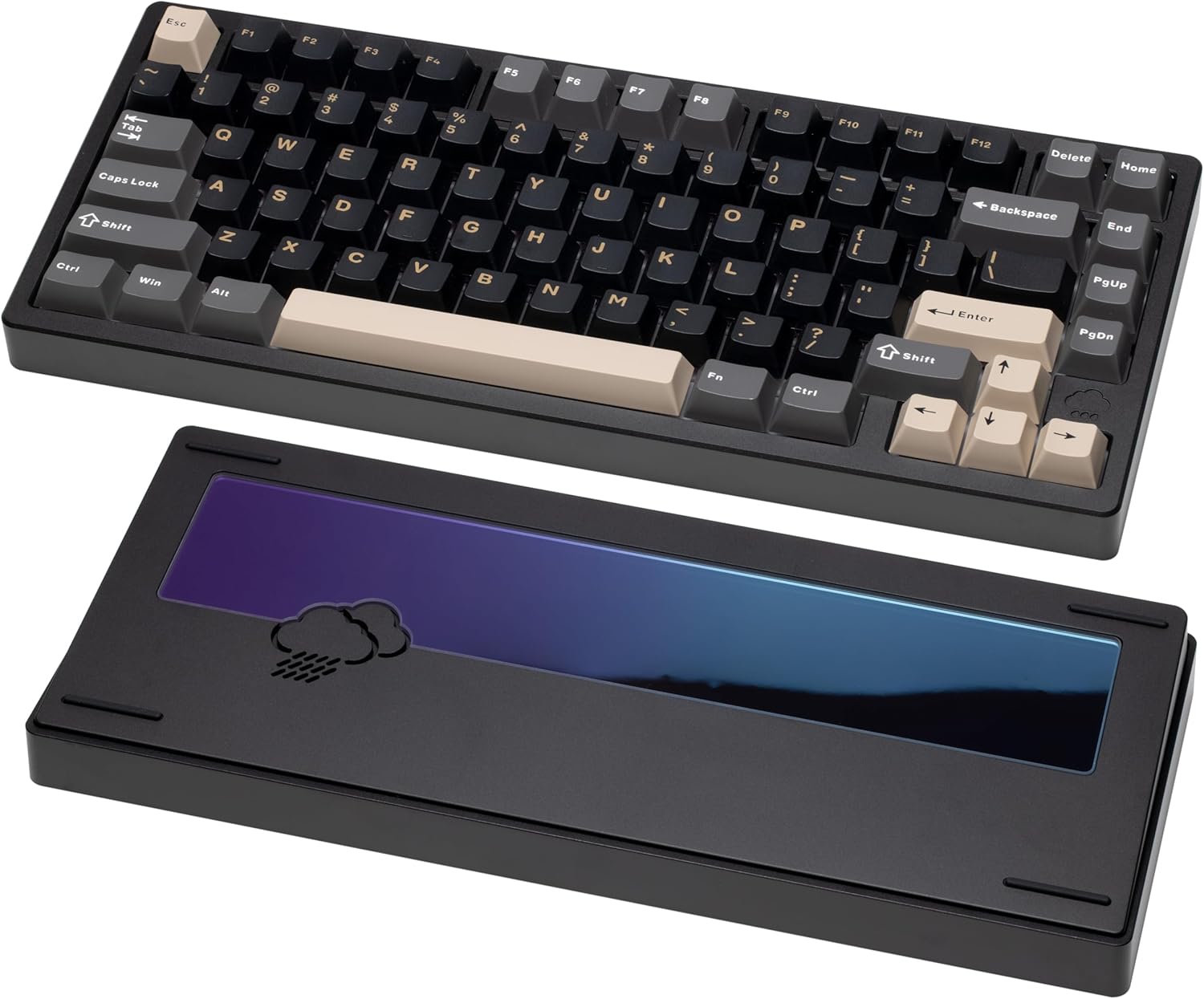
The Wobkey Rainy 75 landed quietly, but it's been hard to ignore. For $129–$159, you get a CNC-machined aluminum case, gasket mount, five-layer acoustic dampening, and tri-mode wireless — a spec sheet that would have cost twice as much a few years ago. This review breaks down what you're actually getting, where Wobkey made smart tradeoffs, and who this board is really for.
What Is the Wobkey Rainy 75?
The Rainy 75 is Wobkey's self-described first "audiophile keyboard." It's a 75% layout — think tenkeyless but trimmed further, keeping dedicated arrow keys and a function row while cutting the numpad and some navigation cluster. That balance makes it one of the more practical form factors if you want a compact desk footprint without sacrificing daily usability.
Three tiers are available:
| Tier | Price | Plate | Battery | RGB | Stabs |
|---|---|---|---|---|---|
| Lite | $129.99 | Polycarbonate | 3500mAh | No | Standard |
| Standard | $139.99 | Polycarbonate | 3500mAh | Yes | Standard |
| Pro | $159.99 | FR4 | 7000mAh | Yes | SUS304 Silver |
A Limited Edition Anodized Navy colorway also exists at $199.99 for those who want something more distinctive.
Rainy 75 Built vs Barebones: Which Version Should You Buy?
Every Rainy 75 tier covered in this review is a built board: it arrives with switches already installed (Violet on the Lite and Standard, WOB or Cocoa on the Pro), so you can plug it in and type. That is the version most buyers want, and it is the one the Amazon listing linked below sells.
A barebones kit (case, plate, PCB and stabilizers, but no switches or keycaps) only makes sense if you already own a switch set and keycaps you want to move over. Wobkey's own listing is the place to confirm whether a barebones Rainy 75 is offered in your region, since availability changes by colorway and restock. Two things to weigh before hunting for one:
- The built version is not a dead end. The PCB is hot-swappable, so you can pull the stock switches later and drop in your own without soldering. Buying built and swapping gives you a working keyboard on day one and a spare switch set.
- Tier matters more than kit type. The plate, stabilizers and battery differ by tier, not by whether switches are included. If you want the FR4 plate, SUS304 stabs and 7000mAh battery, you are choosing the Pro regardless.
For a first custom-style board, buy built. Go barebones only if you have switches and keycaps waiting for a home.
Build Quality and Design
The case is CNC-machined aluminum throughout, with multiple finish options spanning anodized black, anodized silver, electro white, blue, pink, yellow, red velvet, and Luna colorways. Wobkey's "electro" finishes have a slightly textured quality that resists fingerprints better than a standard polish, which is a practical win for a daily driver.
The glass panel detail — either mirrored glass or gradient glass depending on variant — gives the Rainy 75 a design identity that most boards in this price range don't bother with. It's a minimalist aesthetic, but the material detail earns it.
Gasket mount is present across all variants. For typing feel, this matters: the gasket absorbs the impact energy from each keystroke and redirects it away from the case, producing the softer, bouncier feedback that enthusiasts associate with premium boards. Combined with five acoustic dampening layers inside the case, the Rainy 75 is engineered around sound first.
Sound Profile and Typing Feel
This is where the Rainy 75 earns its "audiophile" branding. The combination of a solid aluminum case, gasket suspension, and multi-layer dampening creates a deep, controlled sound signature — what the community calls thocky. There's minimal case ping, very little hollowness, and the dampening keeps the sound from getting muddy. It's one of our top thocky keyboards for exactly that reason.
If you've been shopping for a quiet mechanical keyboard that still has a satisfying keystroke feel, this configuration is hard to beat at the price. The polycarbonate plate on the Lite and Standard variants adds a degree of flex that makes extended typing sessions comfortable. The FR4 plate on the Pro tightens that up slightly, giving a stiffer, snappier return for typists who prefer a more direct feel.
The SUS304 silver stabilizers on the Pro model are a notable upgrade. Stabilizer quality is one of the most audible variables in any keyboard build — cheap stabilizers produce the rattle and clunk that makes otherwise good boards sound mediocre. Pre-speccing better stabs at the Pro tier is a smart move by Wobkey.
Rainy 75 Switch Options: Violet vs WOB vs Cocoa
The Rainy 75 ships with your choice of switch depending on the variant:
| Switch | Type | Available on | Best for |
|---|---|---|---|
| Violet | Linear, medium weight | Lite, Standard | Smooth all-day typing |
| WOB | Linear, heavier, deeper sound | Pro | The thockiest out-of-box sound |
| Cocoa | Tactile | Pro | Feedback on every keypress |
Violet Switch (Lite and Standard): Wobkey's in-house linear, tuned for a smooth, medium-weight feel. It sits in the range of keyboard switches designed for comfortable daily typing — not featherlight gaming linears, not heavy tactiles.
WOB Switch (Pro): A heavier linear with a deeper, more pronounced sound profile. Pairs especially well with the FR4 plate and dampened case on the Pro configuration. If you want what most people mean when they talk about creamy keyboard switches, this is the direction to look.
Cocoa Switch (Pro alternate): A tactile option for typists who want feedback with each keypress. The bump is noticeable without being fatiguing over long sessions.
If you want to swap down the road, the Rainy 75's PCB is hot-swappable, so you're not locked in. That opens the door to exploring options like the Gateron Oil King for a darker, heavier linear sound, or Drop + Invyr Holy Pandas if you want a reference-tier tactile.
Wireless and Connectivity
The Rainy 75 is a tri-mode wireless mechanical keyboard: USB-C wired, 2.4GHz dongle, and Bluetooth. Bluetooth supports multi-device pairing, so you can switch between a desktop and laptop without replugging anything. The 2.4GHz mode is the better choice for latency-sensitive use — gaming or fast typists who notice wireless lag.
Battery life varies by tier. The 3500mAh on the Lite and Standard models is enough for days of typical office use with RGB off. The Pro's 7000mAh doubles that capacity, which makes a meaningful difference if you're heavy on backlighting or regularly forget to charge.
How It Compares
The Rainy 75 competes in a well-populated tier. The Keychron V1 Max is the closest reference point from Keychron — 75%, double-gasket design, QMK/VIA support, tri-mode wireless and a rotary knob. Its case is plastic rather than aluminum, so the Rainy 75 is the heavier, more solid-feeling board, while the V1 Max wins if software programmability and a knob are priorities. Our Keychron V1 Max guide has the full spec rundown.
If you're comparing the Rainy 75 to the Keychron K2 Max, that board leans more Mac-friendly: it ships with macOS keycaps in the box and connects over 2.4 GHz, Bluetooth, or USB-C.
Want more options in this size? See our roundup of the best 75% keyboards, or read the 75% keyboard layout explained if you're still deciding on the form factor.
Who Is the Wobkey Rainy 75 For?
The Rainy 75 is a strong pick if:
- You want a 75% layout with wireless flexibility and don't want to compromise on case quality
- Sound is your priority — this board is built around acoustic performance from the inside out
- You want the Pro's upgraded stabilizers and larger battery for the most complete out-of-box experience
- You care about aesthetics — the color range and glass panel detail give it a shelf presence most boards at this price lack
It may not be the right call if you need QMK/VIA programmability (not confirmed on this board), require a standard knob/rotary dial, or are buying your first mechanical keyboard and don't need audiophile tuning in the spec sheet.
Verdict
The Wobkey Rainy 75 is one of the better-positioned keyboards in the sub-$160 75% aluminum category. The five-layer dampening and gasket mount mean the sound profile is genuinely competitive with boards costing more. The Pro tier's stabilizer and battery upgrades are meaningful enough to be worth the $20 step-up from Standard if this will be your daily driver.
For most people, the Standard at $139.99 is the sweet spot — RGB, polycarbonate plate flex, and a solid aluminum shell without overpaying. The Lite saves $10 by cutting RGB, which is a reasonable tradeoff if you work in a bright environment and don't use backlighting.
Check the Wobkey Rainy 75 on Amazon — available in Standard, Lite, Pro, and Limited Edition colorways.